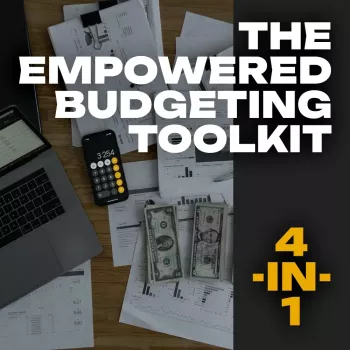
The Empowered Budgeting Toolkit: A 4-in-1 System for Monthly Clarity, Savings Momentum, and Wealth-Building Habits
A budget works best when it’s both practical and motivating. The right tools make money decisions feel clear, repeatable, and aligned with long-term goals—without turning every purchase into a guilt spiral. The Empowered Budgeting Toolkit combines a structured planner, an Excel-based tracking approach, savings organization, wealth strategies, and guided affirmations designed to help you stay consistent month after month.
What’s Included in the 4-in-1 Bundle
This bundle is built as a complete loop, so you’re not just planning—you’re following through and improving with each cycle. It’s designed to work as a complete system: plan → track → review → refine.
- Budget planner framework for mapping income, bills, variable spending, and goals month by month
- Excel guide for tracking expenses and visualizing where money is going (and what to adjust next month)
- Savings structure to turn irregular goals (emergency fund, vacations, debt payoff) into monthly contributions
- Wealth strategies + guided affirmations to reinforce consistent behaviors and reduce impulse-driven decisions
- Designed to work as a complete system: plan → track → review → refine
Bundle Overview at a Glance
| Component |
Primary Purpose |
Best Time to Use |
| Budget Planner |
Set monthly spending limits and assign every dollar a job |
Before the month begins |
| Excel Guide |
Track real spending and spot patterns quickly |
Weekly or after purchases |
| Savings & Goals Tools |
Automate progress toward short- and long-term goals |
On payday / monthly check-in |
| Wealth Strategies + Affirmations |
Build consistency, confidence, and decision discipline |
Daily or during reviews |
If you want the full system in one place, start with The Empowered Budgeting Toolkit 4-in-1 Bundle.
Who This Toolkit Fits Best
- Beginners who want a step-by-step structure instead of starting from a blank spreadsheet
- Anyone juggling variable expenses and needing a clearer view of discretionary spending
- Goal-driven savers who want simple categories (emergency, sinking funds, big purchases) without complexity
- People who prefer a mindset + mechanics combination: numbers paired with reinforcing routines
- Households building a repeatable monthly process (solo or with a partner)
For extra guidance on budgeting and cash flow basics, the Consumer Financial Protection Bureau has a solid overview that pairs well with a structured monthly workflow.
A Simple Monthly Flow: Plan, Track, Review, Reset
The fastest way to make budgeting feel easier is to make it routine. This flow is simple enough to repeat and flexible enough to improve.
- Plan (15–30 minutes): list income dates, fixed bills, minimum debt payments, and savings targets.
- Set spending guardrails: choose 3–6 variable categories that tend to drift (food, shopping, subscriptions, etc.).
- Track (10 minutes weekly): enter or import expenses into Excel and compare actuals against targets.
- Review (end of month): identify the top 1–2 categories that caused overages and decide one change.
- Reset (next month): update targets based on reality—small adjustments compound faster than perfect plans.
Using Excel for Expense Tracking Without Getting Overwhelmed
Excel works best when it stays lightweight. The goal isn’t to capture every penny with perfect labeling—it’s to see what’s true so you can make smarter decisions.
- Start with a clean category list; fewer categories makes tracking more consistent.
- Use a single “catch-all” category temporarily if unsure—then reclassify during weekly review.
- Focus on trends, not perfection: spot patterns in timing, triggers, and recurring leaks.
- Create checkpoints: a mid-month review prevents end-of-month surprises.
- Pair each insight with an action: cancel/renegotiate, swap stores, set caps, or introduce a 24-hour rule.
If your income changes throughout the year (new job, overtime, side income), using the IRS Withholding Estimator can help reduce tax-season surprises and make planning your take-home pay easier.
Building Savings That Actually Sticks
Savings becomes dependable when it’s treated like a monthly line item—not a leftover. A simple structure also protects your emergency fund from being used for predictable costs.
- Separate “emergency fund” from “planned expenses” (sinking funds) to reduce random withdrawals.
- Use payday rules: automate transfers immediately after income hits to avoid spending leftovers.
- Turn big goals into small targets: divide annual costs (car insurance, gifts, travel) into monthly amounts.
- Add a “buffer” line to reduce the need for budget breaks when life happens.
- Celebrate milestones with low-cost rewards to reinforce progress without derailing it.
For additional personal finance education and budgeting practice tools, FDIC Money Smart is a helpful resource.
Wealth Strategies That Pair Well With a Budget Plan
A budget is the operating system; wealth strategies are the upgrade path. When you connect the two, extra money has a clear job instead of disappearing.
Guided Affirmations as a Behavior Tool (Not a Substitute for Math)
Common Roadblocks and Quick Fixes
Suggested Add-Ons for Your Routine
FAQ
Is this toolkit better for beginners or experienced budgeters?
It works for both: beginners get prompts and a clear structure, while experienced budgeters get a repeatable monthly system with Excel visibility, savings organization, and mindset reinforcement.
How much time does the monthly process take?
Plan for about 15–30 minutes to set up the month, around 10 minutes per week to track, and 20–30 minutes for the month-end review. Consistency matters more than adding extra detail.
Do guided affirmations really help with budgeting?
They can support follow-through by reducing avoidance and reinforcing rules you’ve set, especially during planning and review. The results still come from the math: tracking, planning, and making small adjustments each month.
Recommended for you












Leave a comment